
How AI Lead Management Helps Treatment Centers Recover Lost Admissions


Most treatment centers are spending thousands per month to generate leads — and losing more than half of them before anyone picks up the phone.
AI lead management connects the moments that currently break in most admissions pipelines: the missed after-hours call, the form submission that sits for two days, the cold lead list no one has time to work, and the follow-up that never happens. For addiction treatment centers specifically, this is not a nice-to-have efficiency play. It is the difference between someone getting into treatment and someone disappearing back into the cycle.
Why Do Treatment Centers Lose So Many Leads?
Research consistently shows that treatment centers lose up to 60% of qualified leads due to preventable operational gaps. The most common breakdown points are predictable:
Breakdown Point | What Happens | Impact on Admissions |
After-hours calls | Voicemail or no answer | Caller contacts a competitor or changes their mind |
Slow response to web forms | Follow-up takes 24–72 hours | Lead goes cold — odds of contact drop 10x after 5 minutes |
No structured follow-up | Admissions team manages live calls and cold lists simultaneously | Older leads sit dormant indefinitely |
No multilingual intake | Non-English speakers get a generic voicemail | Entire populations go unserved |
No CRM documentation | Call data lives in voicemails and sticky notes | No audit trail, no follow-up triggers, no reporting |
The issue is not that admissions teams do not care. It is that they cannot work a cold list of 3,000 names and manage live inquiries at the same time. Something always gets dropped — and in behavioral health, a dropped lead is a person who asked for help and did not get a response.
What Does AI Lead Management Actually Do for Treatment Centers?
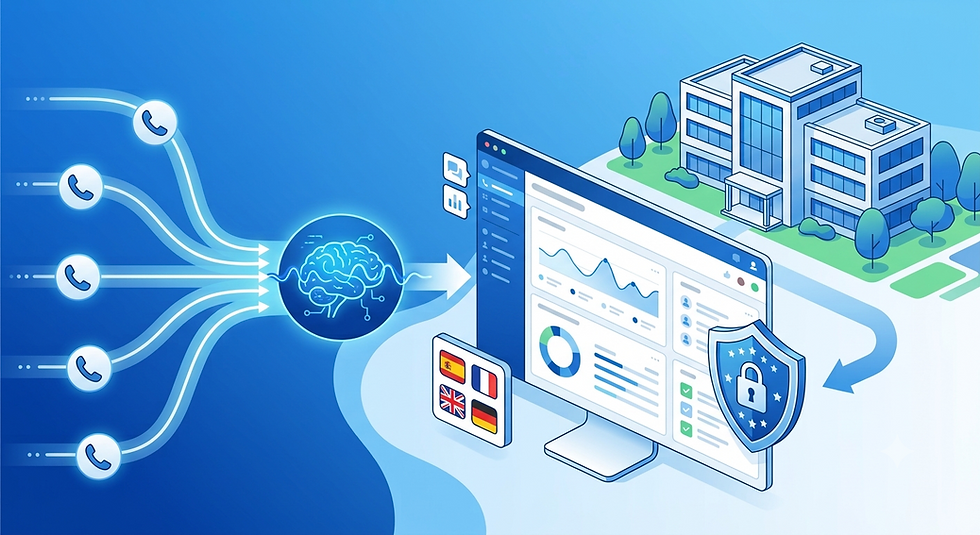
AI lead management for treatment centers is not a chatbot on a website. It is an integrated system that handles inbound calls, outbound re-engagement, structured follow-up, and CRM documentation — all built around the admissions workflow.
Here is what each layer does:
Inbound AI call answering. A HIPAA-compliant AI voice assistant answers every call — nights, weekends, holidays — and conducts a structured intake conversation. It qualifies the caller, determines their stage in the process, and routes them appropriately. Qualified callers get transferred directly to the admissions team. Everyone else gets documented in the CRM with a full transcript and follow-up flag.
Missed-call text-back. When a call goes unanswered by a human, the system automatically sends a text within seconds. This keeps the conversation alive during the window when the caller is still motivated to act.
Outbound lead re-engagement. Dormant CRM contacts — people who filled out a form, started an intake, or called once and never came back — receive HIPAA-compliant outbound text campaigns. The AI handles objections conversationally: insurance concerns, readiness, prior negative experiences, logistical barriers. Contacts who reach a qualified level of engagement get transferred live to admissions.
CRM integration and documentation. Every interaction — inbound call, outbound text, follow-up conversation — gets logged automatically in the treatment center's CRM. Kipu, BestNotes, Lightning Step, Salesforce, HubSpot. No manual data entry. No lost information.
How Does Response Time Affect Admissions Conversion?
Speed to contact is the single most important variable in admissions conversion for behavioral health. The data is not ambiguous:
Response Window | Conversion Impact |
Under 5 minutes | 21x more likely to convert than responding after 30 minutes |
Under 1 hour | 7x more likely to qualify the lead than waiting 2 hours |
After 5 minutes | Lead quality drops by 80% |
Next business day | Caller has likely contacted 2–3 other facilities |
Harvard Business Review research found that companies responding within 5 minutes are 100 times more likely to make contact than those waiting 30 minutes. In addiction treatment, where callers are often in crisis and making a decision they may not make again tomorrow, this gap is even more consequential.
Over half of all treatment center inquiries come in outside standard business hours. If the admissions team only responds 9 to 5, those leads go to whoever picks up first — or they go nowhere at all.
AI lead management closes this gap by responding within seconds, 24/7, without requiring additional staff.
What Happens to Leads That Go Cold?
Every treatment center has a CRM full of contacts who reached out and went quiet. Prior inquiries, incomplete intakes, cold transfers, people who called once and never followed up.
Most centers never re-engage these contacts because the admissions team does not have the capacity. Working a cold list of thousands while managing live intake calls is operationally impossible without a separate system.
AI-powered outbound re-engagement campaigns solve this by running structured, HIPAA-compliant text outreach against dormant lead lists — without pulling a single person off the phones.
Industry benchmarks for healthcare SMS re-engagement campaigns typically range from 5% to 12% response rates. AI-driven campaigns built specifically for behavioral health — with objection handling for insurance, readiness, and prior treatment concerns — have produced engagement rates of 22% on lists that had been dormant for months.
The contacts who respond are not random. They are people who asked for help at some point and are still reachable. Some of them are still asking.
What Does HIPAA Compliance Require in AI Lead Management?
Any AI system handling patient intake calls, outbound outreach, or CRM data in behavioral health must meet specific HIPAA requirements. This is not optional — it is federal law.
Requirement | What It Means |
Business Associate Agreement (BAA) | Must be executed before any data is processed — not after launch |
Encryption at rest and in transit | All call recordings, transcripts, and text messages must be encrypted |
Audit trail | Every interaction must be logged with timestamps and accessible for compliance review |
Crisis escalation protocols | AI must recognize crisis language and route immediately to a live person |
42 CFR Part 2 awareness | Substance use disorder treatment records carry additional federal protections beyond standard HIPAA |
A2P 10DLC compliance | Outbound text campaigns require carrier registration before the first message is sent |
A vendor that cannot produce a signed BAA before onboarding is not HIPAA-compliant. A vendor that sends outbound texts without completing A2P 10DLC registration will get filtered by carriers and may expose the treatment center to regulatory risk.
What Questions Should Treatment Centers Ask Before Choosing an AI Lead Management Platform?
Not all AI platforms are built for behavioral health. Most are adapted from general-purpose tools designed for restaurants, law firms, or e-commerce. Before committing, ask:
Is the platform built exclusively for addiction treatment and behavioral health — or is it a general AI tool with a healthcare add-on?
Will they execute a BAA before onboarding — not after?
Does the AI handle crisis language and escalate to a live person immediately?
Does it integrate directly with your existing CRM — Kipu, BestNotes, Lightning Step, Salesforce, or HubSpot?
Can it conduct intake conversations in multiple languages?
Does it support outbound re-engagement campaigns with A2P compliance built in?
Is setup and support U.S.-based?
Can they provide case study data from treatment centers — not restaurants or dental offices?
The difference between a platform that understands admissions workflows and one that handles appointment scheduling is the difference between recovering admissions and generating noise.
Who Provides AI Lead Management for Treatment Centers
Blueshirt Media provides HIPAA-compliant AI call answering, missed-call text-back, outbound lead re-engagement, and CRM integration — exclusively for addiction treatment centers and recovery programs. We integrate directly with Kipu, BestNotes, Lightning Step, Salesforce, and HubSpot — so your admissions team sees every lead, every follow-up, and every recovered admission in one place.
We don't adapt general-purpose AI tools for behavioral health. Every workflow is built around the admissions process from the start — including BAA execution before onboarding, U.S.-based setup and support, and crisis escalation protocols built into every conversation.
Want to see how it works for your center?
Frequently Asked Questions
What is AI lead management for treatment centers? AI lead management for treatment centers is an integrated system that handles inbound call answering, missed-call text-back, outbound lead re-engagement, and CRM documentation — all built around the behavioral health admissions process. It ensures no inquiry goes unanswered and no dormant lead stays dormant without at least one more attempt.
Does AI lead management replace the admissions team? No. AI lead management handles the volume, timing, and follow-up that admissions teams cannot cover alone — after-hours calls, weekend inquiries, and cold lead outreach. Qualified callers are transferred directly to the admissions team for live conversation. The AI extends the team's reach without replacing their expertise.
Is AI lead management HIPAA-compliant? It must be. Any AI system processing patient intake calls, outbound texts, or CRM data in behavioral health is required to operate under a signed Business Associate Agreement with encryption, audit trails, and crisis escalation protocols. Platforms that cannot produce a BAA before onboarding do not meet HIPAA requirements.
How does AI outbound re-engagement work for treatment centers? AI-powered outbound campaigns send HIPAA-compliant text messages to dormant CRM contacts — people who previously inquired but never completed intake. The AI handles common objections conversationally, including insurance concerns, readiness, and prior treatment experiences. Contacts who reach a qualified level of engagement are transferred live to the admissions team.
What CRM systems does AI lead management integrate with? Leading platforms integrate directly with behavioral health CRMs including Kipu, BestNotes, and Lightning Step, as well as general CRMs like Salesforce and HubSpot. Direct integration means every call, text, and follow-up is logged automatically — no manual data entry required.
How quickly does AI respond to incoming leads? AI lead management responds within seconds — to both inbound calls and missed-call text-back. Research shows that responding within 5 minutes makes a treatment center 21 times more likely to convert a lead compared to a 30-minute response window. AI eliminates the delay entirely.


Comments