
How AI Lead Management Works for Recovery Facilities

80% of people who needed substance use disorder treatment in 2024 did not receive it, according to SAMHSA's National Survey on Drug Use and Health. That means millions of people reached out — or thought about reaching out — and fell through the cracks. For treatment centers, the gap between someone asking for help and actually starting treatment is where admissions are won or lost. AI lead management exists to close that gap.
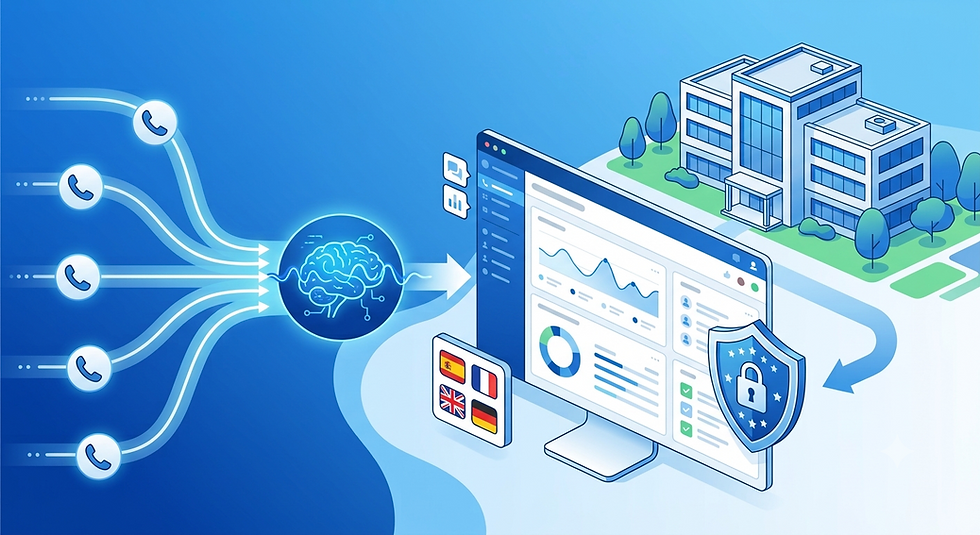
AI lead management for recovery facilities is a system that captures every inbound call, responds to missed calls automatically, re-engages dormant contacts in your CRM, and routes qualified conversations to your admissions team — all under HIPAA-compliant infrastructure with a signed Business Associate Agreement in place before a single interaction occurs.
How AI Lead Management Actually Works for Treatment Centers
The process is different from what most treatment center operators expect. This is not a chatbot on your website. It is a managed AI system that handles voice, text, and CRM workflows across the full admissions pipeline.
Here is how it works, step by step:
Step | What Happens | Why It Matters |
1. Inbound call answered | AI picks up every call 24/7 — nights, weekends, holidays | No voicemail, no missed calls, no lost admissions |
2. Caller qualification | AI conducts structured intake questions: insurance, substance, readiness, location | Only qualified callers reach your admissions team |
3. Live transfer | High-intent callers are transferred directly to admissions staff in real time | No callback delay — the person gets help while they are ready |
4. Missed-call text-back | If a call is missed by the AI or staff, a HIPAA-compliant text goes out immediately | Keeps the conversation open before the caller contacts a competitor |
5. CRM logging | Every interaction — transcript, qualification outcome, follow-up status — is logged to your CRM | Admissions sees every lead in one place without chasing data |
6. Dormant lead re-engagement | AI outbound text campaigns contact people who previously reached out but never completed intake | Recovers admissions from contacts your team cannot manually work |
7. Objection handling | AI engages each respondent conversationally — addressing cost, readiness, insurance, and prior treatment concerns | Moves people past the barriers that keep them from starting treatment |
8. Transfer or follow-up | Qualified contacts are transferred live to admissions; others enter a follow-up sequence | Every lead gets a next step — nobody falls through |
This is a managed service, not a software license. Your team does not configure prompts, build workflows, or manage integrations. The provider handles setup, compliance, CRM integration, and ongoing optimization.
What Happens When a Caller Is a Family Member?
A significant percentage of calls to treatment centers come from family members — a parent calling about an adult child, a spouse asking what options exist, or an attorney calling on behalf of a client. AI lead management systems built for behavioral health recognize this immediately.
The AI adjusts the conversation to gather the right information: the relationship to the person seeking treatment, the substance involved, insurance details if known, and whether the person in need has expressed willingness to enter treatment. Family callers are either connected to admissions staff who can guide next steps or given specific follow-up instructions, depending on the center's protocol.
Generic AI systems treat every caller the same. Behavioral health AI distinguishes between a court-mandated DUI intake, a parent in crisis at midnight, and a person calling for themselves for the first time.
How Does AI Lead Management Handle After-Hours Calls?
After-hours calls are where most treatment centers lose the most admissions. A person in crisis does not call during business hours and leave a voicemail. They call when they are ready — which is often at 2 a.m. on a Saturday.
AI lead management answers every after-hours call the same way it answers calls at 10 a.m. on a Tuesday. The AI conducts the same structured intake, qualifies the caller, and either transfers them directly to an on-call admissions counselor or captures the full intake conversation for first-thing follow-up.
One treatment center client — Livengrin Foundation in Bucks County, Pennsylvania — handles 650+ inbound calls per month through AI lead management, including nights, weekends, and holidays. The result: zero missed calls, 34 direct treatment transfers monthly, and 175 new DUI clients enrolled, with multilingual support in English, Spanish, and Russian.
What Is the Difference Between a Managed AI Service and an AI Platform?
This is the most important distinction treatment center operators need to understand before buying anything. The two models look similar on a features page but operate completely differently in practice.
Factor | Managed AI Service | AI Platform (Self-Service) |
Setup | Provider builds and configures everything | Your team builds workflows, prompts, and integrations |
HIPAA compliance | BAA executed before onboarding; provider maintains compliance | You are responsible for configuring HIPAA-compliant settings |
CRM integration | Direct integration with Kipu, BestNotes, Lightning Step, Salesforce, HubSpot | You build and maintain the integration yourself |
Crisis escalation | Built-in protocols for callers in immediate danger | You must configure escalation logic |
Support model | U.S.-based, ongoing, managed by the provider | Ticket-based or self-service documentation |
Deployment timeline | Most centers live within one week of BAA execution and A2P registration | Weeks to months depending on internal technical capacity |
Optimization | Provider monitors and adjusts call flows, qualification criteria, and objection handling | Your team monitors and adjusts |
42 CFR Part 2 compliance | Provider handles the additional confidentiality protections required for substance use disorder treatment records | You must understand and implement Part 2 requirements independently |
A managed AI service means your admissions team focuses on admissions. You do not need a technical team to maintain the system. The provider handles compliance, integrations, optimization, and support.
An AI platform gives you tools. What you build with them — and whether it stays compliant — is your responsibility.
HIPAA Compliance and 42 CFR Part 2 in AI Lead Management
Any AI system handling calls or messages related to substance use disorder treatment must operate under HIPAA. That is non-negotiable. But HIPAA alone is not enough.
42 CFR Part 2 is a federal regulation that provides additional confidentiality protections specifically for substance use disorder treatment records. It restricts how patient-identifying information can be disclosed, requires written consent for most disclosures, and applies to any program that receives federal funding or is federally assisted — which includes most treatment centers.
For AI lead management, this means:
Every call recording, transcript, and data point must be encrypted at rest and in transit
A signed Business Associate Agreement must be in place before any patient-identifying information is handled
Outbound text messages must be non-identifying — no mention of treatment, substance use, or facility name in the message body
A2P 10DLC registration must be completed before any outbound campaign launches, protecting sender reputation and ensuring carrier delivery
Audit trails must document every interaction for compliance review
Crisis escalation protocols must be built into every conversation, routing callers in immediate danger to appropriate resources
If a vendor cannot explain how they handle 42 CFR Part 2, they are not built for this space.
What CRM Integrations Matter for Treatment Center Lead Management?
CRM integration is what separates a lead management system from a glorified answering service. Without integration, every AI-handled call creates a manual data entry task for your admissions team — which defeats the purpose.
The CRMs that matter in behavioral health are not the same ones that matter in general business. Treatment centers run on specialized platforms:
Kipu — the most widely used behavioral health EHR/CRM
BestNotes — popular among mid-size treatment programs
Lightning Step — used across residential and outpatient facilities
Salesforce — used by larger multi-site organizations
HubSpot — used for marketing and admissions pipeline management
A managed AI lead management service integrates directly with these platforms. Every call, every text reply, every qualification outcome, and every transfer is logged automatically. Your admissions team sees the full picture in the system they already use — no switching between platforms, no manual entry, no lost data.
Questions to Ask Before You Buy AI Lead Management
Not every provider claiming to offer AI lead management for treatment centers is actually built for behavioral health. These questions separate vendors who understand the space from those who adapted a general-purpose tool:
Do you execute a BAA before onboarding, or after?
Are you compliant with 42 CFR Part 2, and can you explain how?
Do you integrate directly with Kipu, BestNotes, or Lightning Step — or only with general CRMs?
Is your AI trained on behavioral health intake workflows, or is it a general-purpose voice bot?
Do you handle A2P 10DLC registration for outbound campaigns?
What happens when a caller is in immediate crisis — is there a built-in escalation protocol?
Can your system distinguish between a person calling for themselves and a family member calling on their behalf?
What does your deployment timeline look like — days, weeks, or months?
If the answer to any of these is vague, that vendor is not built for recovery facilities.
What Does a Real AI Lead Re-Engagement Campaign Look Like?
Most treatment centers have hundreds or thousands of contacts sitting dormant in their CRM — people who called once, filled out a form, or started intake and never came back. Admissions teams cannot manually work a cold list while managing live inquiries at the same time.
One multi-site behavioral health organization had 5,000 inactive contacts. Blueshirt Media built and executed a two-phase AI outbound text re-engagement campaign against the full list. The results:
Metric | Result |
Inactive leads contacted | 5,000 |
Engagement rate | 22% (industry benchmark: 5–12%) |
Calls transferred to admissions | 25 |
Conversations exceeding 5 minutes | 5 (highest-intent signal) |
Time from A2P approval to first message | 1 week |
Campaign ROI | Client confirmed it paid for itself |
The AI handled every reply conversationally — addressing objections around cost, insurance, readiness, and prior negative treatment experiences. This is not a blast text. It is a managed, HIPAA-compliant re-engagement system that meets people where they are and transfers them to admissions when they are ready.
Who Provides AI Lead Management for Treatment Centers
Blueshirt Media provides HIPAA-compliant AI call answering, missed-call text-back, outbound lead re-engagement, and CRM-integrated lead management exclusively for addiction treatment centers and recovery programs. We integrate directly with Kipu, BestNotes, Lightning Step, Salesforce, and HubSpot — so your admissions team sees every lead, every follow-up, and every recovered admission in one place.
We don't adapt general-purpose AI tools for behavioral health. Every workflow is built around the admissions process from the start — including BAA execution before onboarding, U.S.-based setup and support, and crisis escalation protocols built into every conversation.
Want to see how it works for your center?
Frequently Asked Questions
How do AI-powered lead management solutions work for recovery facilities?
AI lead management for recovery facilities captures every inbound call 24/7, qualifies callers through structured behavioral health intake workflows, transfers high-intent callers directly to admissions staff, sends automatic HIPAA-compliant texts for missed calls, and re-engages dormant CRM contacts through outbound campaigns. Every interaction is logged to the treatment center's CRM automatically.
How does AI lead management work for after-hours calls?
The AI answers after-hours calls identically to daytime calls — conducting the same structured intake, qualifying the caller, and either transferring to an on-call admissions counselor or capturing the full conversation for priority follow-up. There is no voicemail, no callback delay, and no missed opportunity.
What happens when a caller is a family member?
AI systems built for behavioral health recognize family callers and adjust the conversation accordingly, gathering the relationship to the person seeking treatment, substance involved, insurance details if known, and whether the person in need has expressed willingness to enter treatment. Family members receive appropriate guidance or are connected to admissions staff.
What is the difference between a managed AI service and an AI platform for treatment centers?
A managed AI service handles setup, HIPAA compliance, CRM integration, crisis escalation protocols, and ongoing optimization — your admissions team focuses on admissions. An AI platform gives you self-service tools to build your own workflows, and you are responsible for compliance, integrations, and maintenance.
Does AI lead management comply with 42 CFR Part 2?
A properly built system does. 42 CFR Part 2 provides additional confidentiality protections for substance use disorder treatment records beyond HIPAA. Compliant AI lead management uses non-identifying outbound messages, encrypted data handling, BAA execution before onboarding, and consent-based disclosure protocols.
How long does it take to deploy AI lead management at a treatment center?
With a managed AI service provider, most treatment centers are live within one week of BAA execution and A2P 10DLC registration. Self-service AI platforms typically require
weeks to months depending on internal technical capacity and compliance configuration.


Comments